
Space Gringos
The billionaire space class has built the most expensive deus ex machina in history.


There is a word for people who arrive somewhere with enough capital to exempt them from local consequence. They extract what they need, damage what they don’t, and leave. Historically, the Latin American word was gringo. For today’s plutocrat cosmonauts, it’s space gringo, and they’ve got an exit plan.
In classical Greek drama, the deus ex machina was a god lowered onto the stage by a crane to resolve a plot the playwright couldn’t close. Aristotle considered it a failure of craft. The problems were still there when the theater emptied. The machine just made them temporarily invisible.
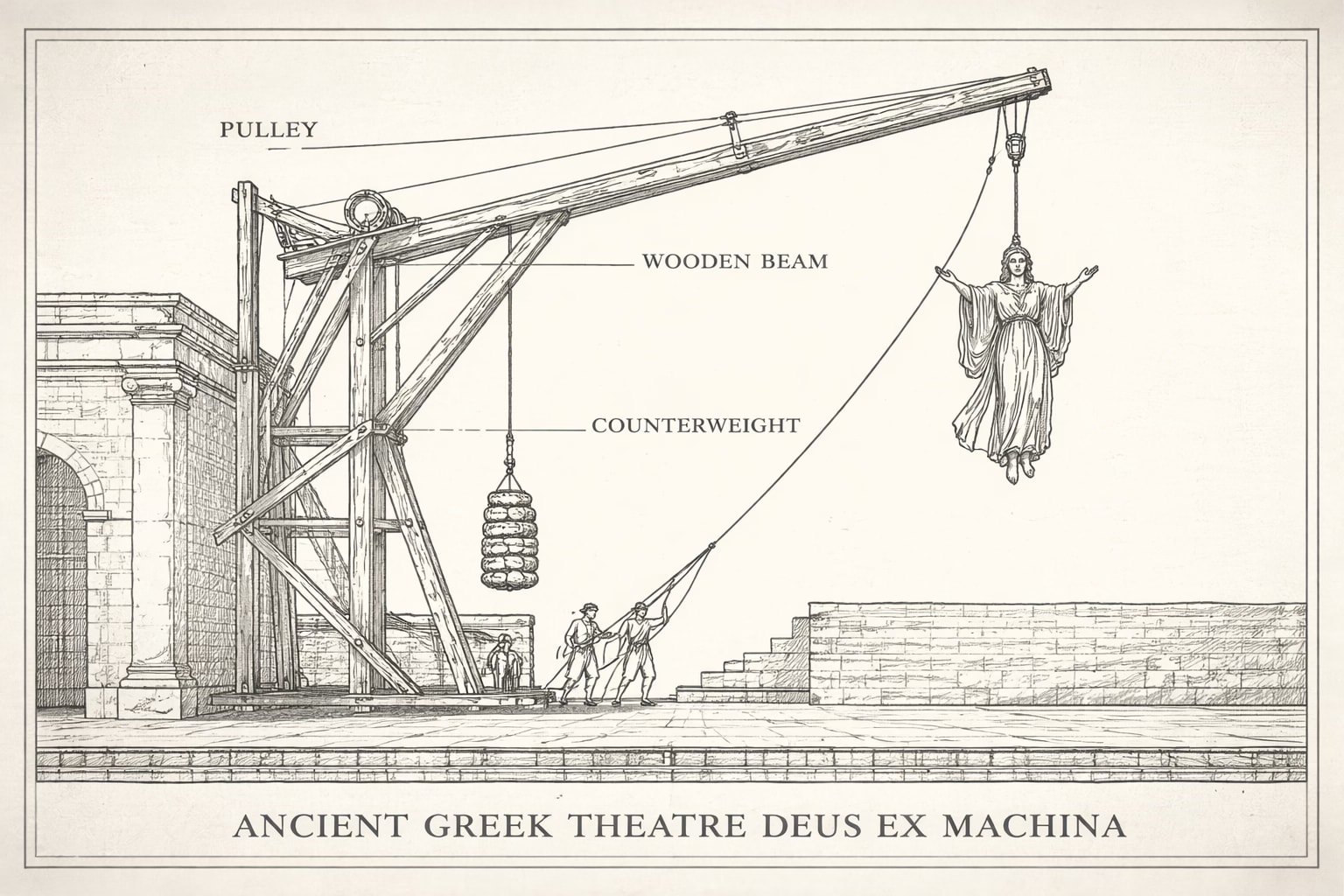
The billionaire space class has built the most expensive deus ex machina in human history.
Katy Perry went to space. She burned the carbon equivalent of twenty acres of wheat, floated for twenty minutes, looked out the window at the Earth below, wept, and then posted.
Jeff Bezos went up in a cowboy hat. He came back and thanked Amazon workers for paying for his ticket. There was champagne on the tarmac.
William Shatner also went up at 90 years old and came back unable to speak. He tried to describe what he’d seen to Bezos and couldn’t finish his sentences. He had expected wonder and felt grief. The Earth had looked thin. The universe above was dark like death, cold and indifferent. He stood there trying to find the words while Bezos poured the champagne, waited for sound-bite coherence and finally awkwardly walked away.
Everyone who went as a celebrity or billionaire adventurer came back with content. Only the actor came back with a true reckoning.
Musk’s case for Mars is different; a multi-planetary species is harder to extinguish. The logic is sound as far as it goes, if you can ignore its vaguely messianic tone. What it quietly assumes is that Earth is a problem to be escaped rather than solved, and that the people with the resources to do either have chosen correctly.
It used to be simpler for billionaires. During the pandemic, when the world looked terminal, you bought your place in New Zealand, staffed it with private security, and prepared to decamp when it all went sideways. The bunker was the honest version of the exit fantasy; unglamorous, paranoid, earthbound.
Now you take ketamine with Elon Musk and the two of you plan to die on Mars. The bunker becomes a rocket. The paranoia becomes a zeitgeist. The exit fantasy went from private and shameful to public and aspirational.
This is not without precedent. As Rome fragmented, the senatorial aristocracy retreated to fortified estates, kept the slaves and the libraries, and let the infrastructure they’d spent centuries benefiting from collapse around them. The French émigrés fled the Revolution certain the madness was temporary, spent decades in exile, and returned to find a country reorganized entirely around their absence. Their exit didn’t protect the system. It accelerated the conclusion by removing the people who might have renegotiated its reform.
Today’s Mars bound billionaires are émigrés with rockets, convinced the Earth is a problem they can exit.
But there is a structural flaw in this plutocratic exit fantasy; most of them can’t run a dishwasher.
The space gringos are gold-plated refugees, not pioneers. They can construct a narrative, allocate capital, arbitrage their way through legislatures. What they cannot do is weld a pressure hull, diagnose a failing CO2 scrubber, or grow food. The skills that generate billion-dollar deals are precisely useless in a closed-loop life support system where one failed seal is a mass casualty event. Early Jamestown settlers, disproportionately aristocratic, starved on arable land in part because the inhabitants had no training for actual survival. Turns out exigent circumstances don’t negotiate with social rank or wealth.
A Mars habitat is not a yacht. The knowledge required to keep it alive belongs almost entirely to people who can’t afford a ticket. Which means the actual Mars colony, if it ever exists, will be staffed by a technical working class with potentially no legal protections, no union, no exit of their own, dependent on life-support infrastructure owned by the guy who signs the checks. The 1967 Outer Space Treaty says nothing coherent about private celestial employment.
The deus ex machina was ancient Greece’s cheat code. The god descended, pronounced resolution, and the audience went home. The problems that drove the plot were still there when the theater emptied. The machine didn’t solve anything. It just allowed everyone on stage to pretend, for a moment, that the conundrum had finally come to an end.
The rich are different from you and me. They’re moving to Mars. The rest of us are staying here, in a plot twist the billionaires helped create but couldn’t be bothered to fix.
Shatner got it. The rest of them apparently got past it.
What are your thoughts about Musk and Bezos’ firms winning prime defense contracts with the US Department of War?